Why Business Owners Pay More Tax Than Employees in Pakistan (TY2027)
A direct comparison of Pakistan's salaried versus non-salaried tax slabs: the 1% vs 15% gap, top surcharge survival, and structural policy differences.
TL;DR
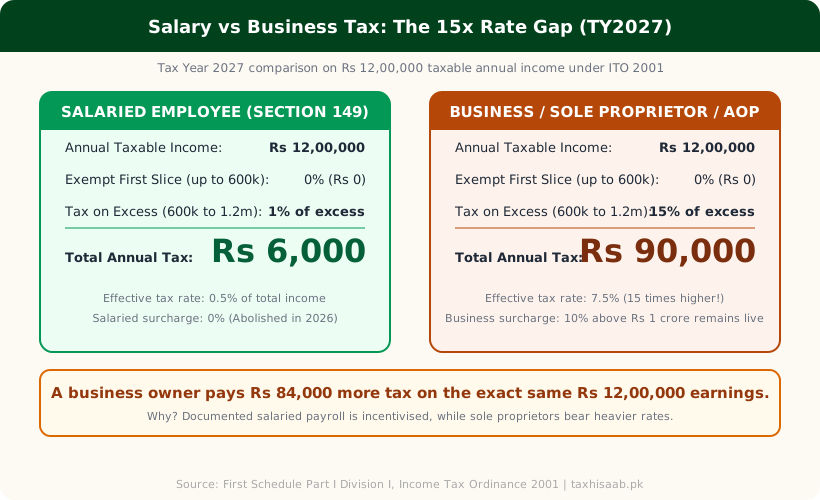
In Pakistan, small business owners, sole proprietors, and partners in an Association of Persons (AOP) face significantly steeper tax slabs than salaried employees. On the first taxable slab above the shared Rs 600,000 exemption (Rs 6,00,001 to Rs 12,00,000), a salaried employee pays just 1% in tax, while a business owner pays 15%. On Rs 12,00,000 in net taxable profit, a business owner pays Rs 90,000 compared to just Rs 6,000 for an employee.
When entrepreneurs transition from full-time employment to running their own sole proprietorship or consultancy, their first tax return often comes as an unpleasant shock.
Many founders assume that because their net profit equals their former corporate salary, their income tax will be roughly the same.
In Pakistan, it is not. The tax system treats business income and employment earnings under two entirely different rate schedules.
See the exact arithmetic for your enterprise using our business tax calculator and compare it against our salary tax calculator.
The Definition: Salaried vs Non-Salaried Taxpayers
Under Division I, Part I of the First Schedule to the Income Tax Ordinance, 2001, you qualify as a salaried individual only if your salary constitutes more than 75% of your total taxable income.
If your salary falls below that 75% threshold, or if you earn your livelihood entirely as an independent consultant, shopkeeper, trader, freelancer with domestic clients, or partner in an Association of Persons (AOP), you are classified as non-salaried.
Non-salaried taxpayers cannot use the salaried tax table. They must use the non-salaried scale.
The 15x Tax Gap: Comparing the First Taxable Slab
Both salaried and non-salaried individuals share the same initial tax-free exemption threshold: the first Rs 600,000 of annual taxable earnings is taxed at 0%.
The dramatic divergence begins immediately on the very next rupee:
- Salaried slab (Rs 600,001 to Rs 12,00,000): Taxed at 1% of the excess over Rs 600,000.
- Non-salaried slab (Rs 600,001 to Rs 12,00,000): Taxed at 15% of the excess over Rs 600,000.
Let us evaluate what happens to someone with Rs 12,00,000 of net taxable income (Rs 1,00,000 per month):
Salaried Employee:
- Tax on first Rs 6,00,000 (0%): Rs 0
- Tax on next Rs 6,00,000 (1%): Rs 6,000
- Total Tax: Rs 6,000 (Effective Rate: 0.5%)
Business Owner / Sole Proprietor:
- Tax on first Rs 6,00,000 (0%): Rs 0
- Tax on next Rs 6,00,000 (15%): Rs 90,000
- Total Tax: Rs 90,000 (Effective Rate: 7.5%)
The business owner pays Rs 84,000 more tax on the exact same Rs 12,00,000 in taxable earnings. That is a 15-fold difference.
Complete Comparison of Progressive Slabs for Tax Year 2027
As earnings rise, the gap widens further. Review the comparative slab progression established under the Finance Act 2026:
| Taxable Income Tier | Salaried Marginal Rate | Non-Salaried / AOP Marginal Rate |
|---|---|---|
| Up to Rs 600,000 | 0% | 0% |
| Rs 600,001 to Rs 12,00,000 | 1% | 15% |
| Rs 12,00,001 to Rs 16,00,000 | 11% | 20% |
| Rs 16,00,001 to Rs 22,00,000 | 11% | 30% |
| Rs 22,00,001 to Rs 32,00,000 | 20% | 30% |
| Rs 32,00,001 to Rs 41,00,000 | 25% | 40% |
| Rs 41,00,001 to Rs 56,00,000 | 29% | 40% |
| Above Rs 56,00,000 | 32% (to 7m), then 35% | 45% |
Notice that a business owner hits the punitive 45% top marginal rate at just Rs 56,00,000 of taxable profit, whereas a salaried individual caps out at 35% above Rs 70,00,000. Examine both scales in detail on our tax slabs page.
Surcharge Asymmetry: The 10% Business Surcharge
The disparity does not end with slab rates.
When the Finance Act 2026 was gazetted:
- Lawmakers abolished the 9% salaried surcharge on personal incomes above Rs 1 crore.
- Lawmakers retained the 10% surcharge for non-salaried individuals and AOPs earning above Rs 1 crore (Rs 1,00,00,000).
A business owner reporting Rs 1.5 crore in net profit must calculate their tax at the 45% top slab and then add an extra 10% surcharge to the resulting tax bill, creating one of the heaviest individual tax burdens in the region.
Why Does the FBR Tax Business Income So Heavily?
Why does this disparity exist? Tax policymakers point to two distinct structural realities:
- Expense Deductibility: Salaried employees are taxed on their gross salary. They cannot deduct commuting costs, home office utilities, laptops, or professional clothing. In contrast, a business owner is taxed on net profit. A sole proprietor deducts staff salaries, rent, depreciation, utility bills, client entertainment, and marketing expenses before arriving at their taxable profit figure.
- Compliance and Documentation: Salaried payroll is documented and withheld monthly by corporate employers under section 149. The FBR views the discounted salaried scale as an incentive for documented formal employment.
What Should Business Owners Do?
If you run a profitable enterprise generating more than Rs 50,00,000 in net profit per year, operating as an unregistered sole proprietorship or AOP may no longer make financial sense.
Many business owners explore incorporating as a Single Member Company (SMC-Private Limited). Corporate income tax in Pakistan is charged at a flat 29% (plus corporate super tax where applicable), allowing directors to draw a documented salary that qualifies for the lower salaried tax scale.
Consult a licensed chartered accountant to evaluate whether incorporation could optimise your business structure for Tax Year 2027.
This article is for general information and estimation only. It is not professional tax advice. Tax rules in Pakistan change every July with the Finance Act, so always check fbr.gov.pk for current figures or consult a qualified tax practitioner.
Frequently Asked Questions
Why do business owners pay higher tax rates than salaried individuals in Pakistan?
Under the First Schedule of the Income Tax Ordinance, 2001, salaried individuals benefit from subsidised tax slabs because salary is already fully documented and deducted at source. Sole proprietors and partnerships (AOPs) face steeper progressive slabs starting at 15% above the exemption limit.
How much more tax does a sole proprietor pay on Rs 12,00,000 compared to an employee?
On Rs 12,00,000 of taxable income, a salaried employee pays Rs 6,000 (1% on the excess over Rs 600,000). A business owner pays Rs 90,000 (15% on the excess), exactly fifteen times more tax for the same taxable earnings.
What is the maximum tax rate for business individuals and AOPs?
For Tax Year 2027, the top slab for non-salaried individuals and AOPs is 45% on taxable income exceeding Rs 56,00,000. In addition, a 10% surcharge applies on computed tax for taxable income exceeding Rs 1 crore (Rs 10,00,000).
Who qualifies as a salaried individual under Pakistani tax law?
Under Division I of the First Schedule, a taxpayer qualifies for the salaried tax table if salary represents more than 75% of their total annual taxable income.
Check your exact figures on TaxHisaab
Use our interactive Tax Year 2027 calculators to verify your salary withholding, IT export rate, or filer savings in seconds.