Taxes on Buying and Selling Property in Pakistan: 236C, 236K, and CGT Guide
Everything real estate buyers and sellers must know about section 236K advance tax, 236C seller deductions, and flat 15% Capital Gains Tax in Tax Year 2027.
TL;DR
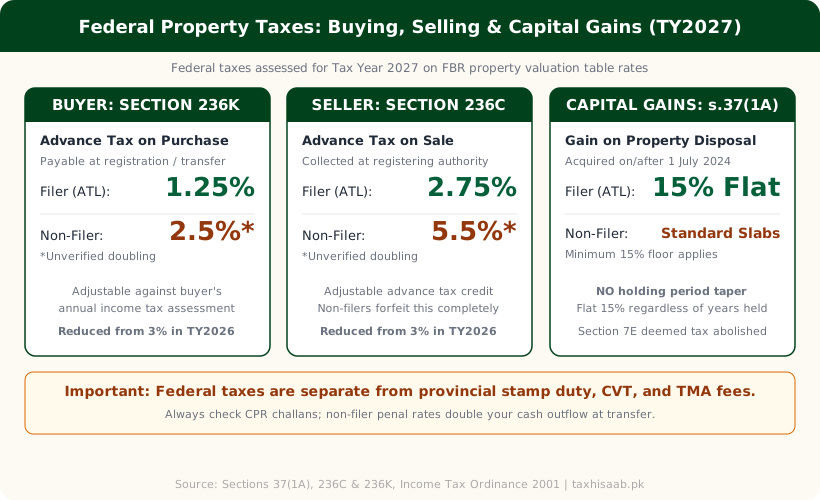
Federal property taxation in Pakistan centres on three statutory provisions under the Income Tax Ordinance, 2001: section 236K advance tax on the buyer (1.25% for filers), section 236C advance tax on the seller (2.75% for filers), and section 37(1A) Capital Gains Tax on profits (flat 15% for filers on properties acquired on or after 1 July 2024). Active filers save heavily on upfront deductions and can adjust advance taxes against their final annual return.
Buying or selling a plot, house, or commercial apartment in Pakistan involves substantial tax deductions at the time of deed registration.
In the past, real estate transactions relied on complex holding-period tables and confusing exemptions. Recent amendments under the Finance Act 2026 have streamlined these rules while maintaining steep penalties for non-filers.
Calculate your exact liability before visiting the registrar with our property tax calculator.
1. Buying Property: Section 236K Advance Tax on the Buyer
When you purchase an immovable property and submit the transfer documents at the sub-registrar, housing society office, or development authority (such as DHA, CDA, or LDA), you must pay advance income tax under section 236K.
What Are the Section 236K Rates for Tax Year 2027?
For active filers on the Active Taxpayer List (ATL), the Finance Act 2026 reduced the section 236K rate from 3.0% down to 1.25%. For non-filers, our reading of the statutory text is that the baseline rate doubles to an inferred 2.5%, though FBR administrative notices have historically applied value-banded scales.
- On a plot valued at Rs 1 crore (Rs 1,00,00,000):
- Active filer pays: Rs 1,25,000 (1.25%)
- Non-filer pays: Rs 2,50,000 (2.5%)
- Cash penalty for non-filers: Rs 1,25,000
Section 236K is an adjustable advance tax. As a filer, you enter this payment in your annual return on IRIS, and the FBR credits the full Rs 1,25,000 against your annual income tax liability. A non-filer forfeits the entire Rs 2,50,000 because they never file. Check what your status saves on our filer vs non-filer calculator.
2. Selling Property: Section 236C Advance Tax on the Seller
When an owner transfers or sells immovable property, the registering authority must collect advance tax from the seller under section 236C before executing the deed.
- Active filer rate: 2.75% of the declared gross consideration (reduced from 3.0% in TY2026).
- Non-filer rate: An unverified inferred rate of 5.5% (doubled rate).
On a Rs 2 crore (Rs 2,00,00,000) transaction:
- A filer pays Rs 5,50,000.
- A non-filer pays Rs 11,00,000.
Section 236C is also an advance adjustable tax. It is credited against the seller's final capital gains tax or general income tax liability when their annual return is submitted.
3. Capital Gains Tax (CGT) Under Section 37(1A)
Capital gains tax is charged on the net profit realised between the purchase cost and the sale price of immovable property.
How Does the Flat 15% Regime Work for Post-July 2024 Acquisitions?
Under amendments introduced in 2024 and maintained for Tax Year 2027, immovable property acquired on or after 1 July 2024 is subject to a flat 15% Capital Gains Tax for active filers. Non-filers are taxed at normal progressive individual slabs, subject to a minimum statutory floor of 15%.
Crucially, the old holding-period taper was eliminated for all acquisitions from 1 July 2024 onward. Whether you hold the property for six months, two years, or five years, your capital gain is taxed at a flat 15%.
For example, if you purchased an open plot for Rs 80,00,000 in August 2024 and sell it in November 2026 for Rs 1,10,00,000:
- Capital Gain: Rs 1,10,00,000 - Rs 80,00,000 = Rs 30,00,000
- CGT Due (15%): Rs 30,00,000 × 15% = Rs 4,50,000
Because your buyer will have already deducted advance tax under section 236C upon transfer, that advance payment is credited directly against this Rs 4,50,000 liability.
What About Properties Acquired Before 1 July 2024?
Properties acquired prior to 1 July 2024 retain the legacy graduated holding-period taper, where the rate gradually reduces for each completed year held. According to PwC Worldwide Tax Summaries, the taper depends on whether the asset is an open plot, constructed building, or flat, eventually reaching 0% after 4 to 6 years of ownership.
FBR Valuation Tables: How Property Value Is Assessed
In Pakistan, property taxes are rarely calculated on private cash agreements. Instead, they are assessed on the higher of:
- The actual sale price declared on the deed.
- The official FBR Property Valuation Table rate notified for that specific city, sector, and street.
The FBR periodically revises these valuation tables to bring declared property values closer to prevailing market reality. Always verify the FBR table rate for your housing sector before calculating transaction fees.
Provincial Taxes You Must Plan For
Federal income taxes under the Income Tax Ordinance, 2001, do not cover provincial levies. When completing a property transfer, you will also encounter:
- Provincial stamp duty: Typically 1% to 2% levied by the Board of Revenue in Punjab, Sindh, Khyber Pakhtunkhwa, or Balochistan.
- Capital Value Tax (CVT): Levied by provincial governments on high-value transfers.
- Town Municipal Administration (TMA) / Society transfer fees: Charged by local municipal bodies or private developers.
Factoring in both federal withholding and provincial transfer fees protects you from unexpected cash shortfalls when closing a real estate deal.
This article is for general information and estimation only. It is not professional tax advice. Tax rules in Pakistan change every July with the Finance Act, so always check fbr.gov.pk for current figures or consult a qualified tax practitioner.
Frequently Asked Questions
What is the tax rate on buying property in Pakistan for filers?
Under section 236K, active filers pay an advance tax of 1.25% of the declared property value, reduced from 3% by the Finance Act 2026. Non-filers pay an unverified inferred rate of 2.5%.
What is section 236C advance tax on selling property?
Under section 236C, active filers pay an advance tax of 2.75% upon the transfer of immovable property. This tax is adjustable against the seller's final annual income tax return.
How is Capital Gains Tax (CGT) calculated on property acquired after 1 July 2024?
Under section 37(1A), immovable property acquired on or after 1 July 2024 is subject to a flat 15% Capital Gains Tax for Active Taxpayer List (ATL) members, regardless of how long the property is held. There is no holding-period taper.
Do federal property taxes include provincial stamp duty?
No. Sections 236C, 236K, and 37(1A) are federal income taxes administered by the FBR. Provincial levies like stamp duty, Capital Value Tax (CVT), and town municipal fees are charged separately by provincial revenue authorities.
Check your exact figures on TaxHisaab
Use our interactive Tax Year 2027 calculators to verify your salary withholding, IT export rate, or filer savings in seconds.